
Industry
Baccarat Strategy: Which Bet to Make and Why
Why betting Banker is the one baccarat strategy that lowers your expected loss, with the full house edge maths, no-commission traps and…
October 25, 2026
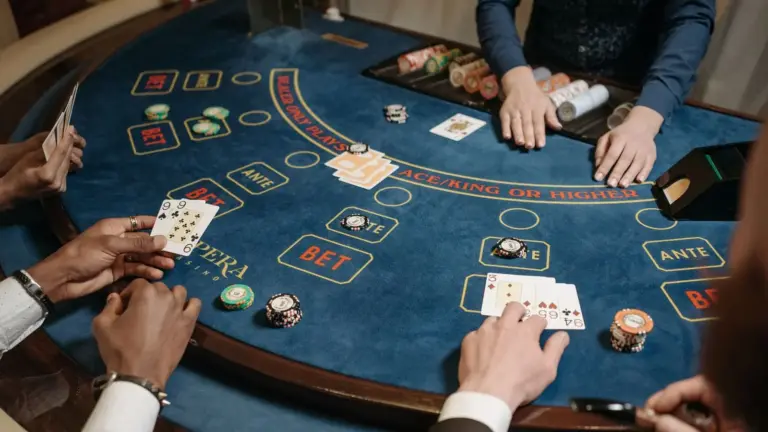
Photo: Sascha Düser / Pexels
Casino games ranked by house edge, from blackjack at 0.28% to keno at 25% or more, with hourly cost maths and the rule changes that move the odds.
The casino games with the best odds are blackjack played with basic strategy (house edge from 0.28%), full-pay Jacks or Better video poker (0.46%), the craps pass line with odds and the baccarat banker bet (1.06%). Keno and most side bets have the worst odds.
Odds in a casino game are measured by the house edge: the average share of each bet the casino keeps. As of October 2026, Wizard of Odds lists blackjack with liberal rules at 0.28%, full-pay Jacks or Better at 0.46%, the baccarat banker at 1.06% and the craps pass line at 1.41%, falling to 0.37% with 3-4-5x odds. Single-zero roulette sits at 2.70%. Keno (25% to 29%), the baccarat tie (14.36%) and most proposition bets are far worse. Rules and pay tables change these numbers within the same game.
In a casino game, “best odds” means the lowest house edge: the smallest average share of each bet that the casino keeps over the long run. A game with a 1% house edge returns, on average, 99 units for every 100 units staked.
Three terms describe the same idea from different sides:
| Term | Meaning | Example: European roulette |
|---|---|---|
| House edge | Average loss as a share of the initial bet | 2.70% |
| Return to player (RTP) | 100% minus the house edge | 97.30% |
| Probability of winning a bet | How often a single bet wins | 18 in 37 (48.6%) for red |
The probability of winning and the house edge are not the same thing. A red bet in European roulette wins 48.6% of the time and pays 1 to 1. The single green zero makes the difference: 18 wins minus 19 losses, divided by 37 spins, gives an average loss of 1 ÷ 37 = 2.70% per bet.
The house edge also assumes correct play. Wizard of Odds notes that its figures assume optimal or near-optimal strategy. A blackjack player who does not follow basic strategy faces a higher edge than the table shows. You can convert any RTP into a house edge with our RTP and house edge calculator.
The casino games with the lowest house edge, according to Wizard of Odds as of October 2026, are blackjack (0.28% with liberal rules), full-pay Jacks or Better (0.46%), the baccarat banker bet (1.06%) and the craps pass lines (about 1.4%).
| Game and bet | House edge | RTP |
|---|---|---|
| Craps: odds bet behind pass or come | 0.00% | 100% |
| Blackjack, liberal Las Vegas rules | 0.28% | 99.72% |
| Blackjack, Atlantic City rules | 0.43% | 99.57% |
| Video poker: Jacks or Better (full pay) | 0.46% | 99.54% |
| Baccarat: banker | 1.06% | 98.94% |
| Baccarat: player | 1.24% | 98.76% |
| Craps: don’t pass / don’t come | 1.36% | 98.64% |
| Craps: pass / come | 1.41% | 98.59% |
| Pai Gow Poker | 1.46% | 98.54% |
| Craps: place 6 or 8 | 1.52% | 98.48% |
| Ultimate Texas Hold’em (ante) | 2.19% | 97.81% |
| Roulette: single zero | 2.70% | 97.30% |
| Casino War (go to war on ties) | 2.88% | 97.12% |
| Three Card Poker (ante and play) | 3.37% | 96.63% |
| Roulette: double zero | 5.26% | 94.74% |
House edges: Wizard of Odds house edge table, last updated August 2026. RTP column: 100% minus the house edge, calculated by our editorial team.
The craps odds bet is the only common casino bet with no house edge. It can only be placed on top of a pass or come bet, which carries 1.41%. With 3-4-5x odds, the combined edge on the total amount staked falls to 0.37%. The full calculation is in How to Play Craps: Rules, Bets and Odds.
Blackjack only reaches its low edge with correct decisions on every hand. Our blackjack strategy guide explains basic strategy. In baccarat, the banker bet is lower than the player bet even after the commission; our baccarat odds guide shows why.
The hourly cost of the house edge equals bet size × bets per hour × house edge. At $10 a bet, an hour of liberal-rules blackjack costs about $1.96 on average; an hour of double-zero roulette costs about $20.
Speed matters as much as the edge. Wizard of Odds publishes average decisions per hour for land-based tables. Our editorial team combined those speeds with the optimal-play house edges:
| Game ($10 per bet) | Bets per hour | House edge | Average cost per hour |
|---|---|---|---|
| Blackjack, liberal rules | 70 | 0.28% | $1.96 |
| Blackjack, Atlantic City rules | 70 | 0.43% | $3.01 |
| Craps: pass line | 48 | 1.41% | $6.77 |
| Baccarat: banker | 72 | 1.06% | $7.63 |
| Roulette: single zero | 35 | 2.70% | $9.45 |
| Big Six wheel: $1 symbol | 10 | 11.11% | $11.11 |
| Casino War | 65 | 2.88% | $18.72 |
| Roulette: double zero | 38 | 5.26% | $19.99 |
Worked example for baccarat: 72 bets × $10 = $720 staked per hour. $720 × 1.06% = $7.63. Casino War has a lower edge than the Big Six wheel, but at 65 hands an hour it costs more per hour. Online play is often faster than these land-based speeds, so the hourly cost rises with it.
These are averages. A single hour can end far above or below them. The average only becomes reliable over thousands of bets.
The casino bets with the worst odds are keno (house edge 25% to 29%), the money wheel or Big Six (11.11% to 24.07%), the baccarat tie (14.36%) and most one-roll craps proposition bets (11.11% to 16.67%), according to the Wizard of Odds table.
| Bet | House edge | Cost of $100 staked, on average |
|---|---|---|
| Keno | 25%–29% | $25–$29 |
| Big Six: joker or logo | 24.07% | $24.07 |
| Craps: any seven | 16.67% | $16.67 |
| Baccarat: tie (8 to 1) | 14.36% | $14.36 |
| Craps: 2, 12 and hard hops | 13.89% | $13.89 |
| Craps: any craps | 11.11% | $11.11 |
| Three Card Poker: Pairplus | 7.28% | $7.28 |
| Slot machines (range) | 2%–15% | $2–$15 |
A pattern runs through the list. Bets with high payouts and a short decision, such as a one-roll craps bet or a tie, usually carry the highest edges. Live game shows built around a money wheel follow the same principle, so check the RTP in each game’s help screen before you play.
Rules and pay tables change the odds of one casino game by several percentage points. A blackjack table paying 6 to 5 instead of 3 to 2 adds 1.39 points to the house edge, and a double-zero wheel nearly doubles the roulette edge.
| Game | Rule change | Effect on house edge |
|---|---|---|
| Blackjack | Blackjack pays 6 to 5 instead of 3 to 2 | +1.39 points |
| Blackjack | Dealer hits soft 17 | +0.22 points |
| Blackjack | No doubling after splitting | +0.14 points |
| Blackjack | Single deck instead of eight decks | −0.48 points |
| Roulette | Double zero instead of single zero | 2.70% → 5.26% |
| Craps | Field pays 3 to 1 on 12 instead of 2 to 1 | 5.56% → 2.78% |
Sources: Wizard of Odds blackjack rule variations (baseline: eight decks, dealer stands on soft 17) and house edge table. Roulette maths: 1 ÷ 37 = 2.70% and 2 ÷ 38 = 5.26%. Our roulette odds guide covers every roulette bet.
The 3-check method finds the version with the lower edge before you place a bet:
The 6-to-5 blackjack rule shows how a small print change outweighs everything else. Wizard of Odds puts its cost at 1.39 percentage points. Added to an Atlantic City game at 0.43%, the edge becomes about 1.82%, higher than the baccarat banker at 1.06% and the craps pass line at 1.41%. A player choosing blackjack for its low edge, then sitting at a 6-to-5 table, ends up with worse odds than both alternatives. The game name says little; the rule card says most.
A betting system cannot beat the house edge in a game with independent outcomes, such as roulette, baccarat or slots. Changing bet sizes changes how results are distributed, not the average loss, which stays the house edge times the total amount staked.
Progressions such as the Martingale double the stake after each loss. They produce many small wins and rare large losses, and the total expected loss is unchanged. The numbers are in The Martingale Strategy Explained with Real Numbers.
Strategy does matter in games where the player makes decisions. In blackjack and video poker, the published low edges depend on correct play. In blackjack, removed cards change the odds of later hands, which is the basis of card counting; the method and its legal status are covered in Card Counting in Blackjack: How It Works and Is It Illegal?
No betting system, progression or “hot table” changes the house edge of an independent game such as roulette, baccarat or a slot. Over many bets, the expected loss is the total amount staked multiplied by the house edge. A low edge means slower losses, not a profit. Decide your budget before you play, never chase losses, and use the deposit limits and other tools on our responsible gambling page. Play only at operators licensed where you live.
Online casino games have the same odds as land-based games when the rules and pay tables are the same, because the house edge comes from the rules, not from the venue. A single-zero roulette game has a 2.70% edge online and offline.
Two differences are worth knowing:
If the question is purely which game loses money slowest, our answer is blackjack with basic strategy at a 3-to-2 table, full-pay video poker played correctly, and the craps pass line with odds. The baccarat banker is the low-edge choice for anyone who wants no decisions at all. We would avoid keno, the baccarat tie and one-roll craps bets entirely: their edges are 10 to 27 times higher than the baccarat banker bet. Just as important, every one of these games still has a positive house edge. The best odds in a casino still mean an expected loss, so choose games for their edge and set a budget before you play.
Blackjack with basic strategy and favourable rules has the lowest house edge among common games, from 0.28% according to Wizard of Odds. Full-pay Jacks or Better video poker (0.46%) is close behind.
Baccarat. The banker bet has a 1.06% house edge and the player bet 1.24%. Single-zero roulette has 2.70% and double-zero roulette 5.26%.
Keno has the highest edge of the common games, at 25% to 29%. Among table bets, the Big Six joker (24.07%) and any seven in craps (16.67%) are among the worst.
Slot odds vary widely. Wizard of Odds gives a house edge range of 2% to 15%. Check the RTP in each game’s rules.
Yes, in the short term. Any single session can win. Over many bets, results move towards the house edge, so the expected result is a loss.
Industry
Why betting Banker is the one baccarat strategy that lowers your expected loss, with the full house edge maths, no-commission traps and…
October 25, 2026

Industry
How the Hi-Lo card counting system works, what edge it gives, why online blackjack defeats it, and where card counting is legal…
October 25, 2026
Industry
Craps rules from the come-out roll to the point, with the four starter bets, odds-bet maths and the house edge of every…
October 25, 2026