

Industry
How Progressive Jackpots Work
Who pays for a progressive jackpot, how the meter grows and resets, what the odds look like, and when the maths can…
October 25, 2026
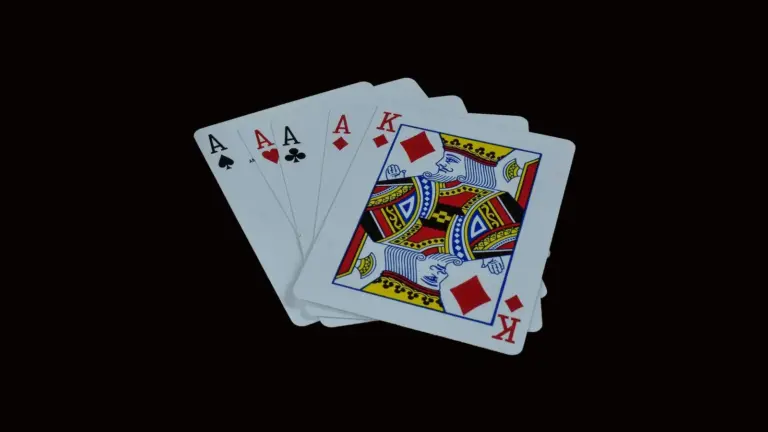
Photo: Pavel Danilyuk / Pexels
Omaha poker rules in practice: the two-plus-three hand rule with examples, pot-limit raise maths, Hi-Lo splits and how PLO differs from Hold'em.
Omaha poker deals each player four hole cards instead of two, and every final hand must use exactly two hole cards plus exactly three of the five board cards. In Pot-Limit Omaha, no bet or raise may exceed the current size of the pot.
Omaha uses the same blinds, board and betting rounds as Texas Hold’em. The differences are in the cards: four hole cards per player, and a final hand made of exactly two hole cards and exactly three board cards. Playing the board is impossible. Most Omaha games are pot-limit, so the largest raise equals the pot after your call. Omaha Hi-Lo splits the pot between the highest hand and the lowest qualifying hand of eight or lower.
An Omaha hand is dealt and played like Texas Hold’em: a button, two blinds, then a three-card flop, a turn and a river, with four betting rounds. The one change at the deal is that each Omaha player receives four hole cards.
Pagat.com gives a table size of two to ten players. The full blinds-and-betting sequence is explained in How to Play Poker: Rules, Betting Rounds and Hand Values.
The “exactly two, exactly three” rule means an Omaha hand always combines two of the player’s four hole cards with three of the five board cards. Robert’s Rules of Poker states that a hand must use “precisely two holecards with three boardcards”.
Each player has 6 possible pairs of hole cards (4 choose 2) and 10 possible sets of three board cards (5 choose 3). That gives 60 five-card combinations per player, against 21 in Texas Hold’em.
The 2+3 check prevents the most common misreads:
| Board | Hole cards | Tempting misread | Actual Omaha hand |
|---|---|---|---|
| A♥ 9♥ 7♥ 4♥ 2♣ | K♥ Q♠ J♠ 10♦ | Flush with the K♥ | Ace high (A-K-Q-9-7): only one heart in hand |
| 8♣ 8♦ 8♥ 8♠ K♦ | A♠ Q♦ 7♣ 5♥ | Four eights | Three eights with A-Q: only three board cards play |
| Q♠ J♦ 10♣ 4♥ 2♠ | K♠ 9♦ 9♥ 3♣ | Pair of nines | King-high straight (K-9 with Q-J-10) |
| 9♠ 9♥ 5♦ 5♣ A♣ | K♦ K♣ 3♥ 2♦ | Nines and fives from the board | Kings and nines, ace kicker (K-K with 9-9-A) |
Analysis of the four hands by our editorial team, using the 2+3 check.
In Pot-Limit Omaha, the maximum raise equals the pot after the raiser’s call is counted. Robert’s Rules of Poker gives the example: with $100 in the pot and a $50 bet, a player may call $50 and raise $200.
The calculation works in three parts:
| Situation | Pot before you act | Call | Maximum raise | Your total bet |
|---|---|---|---|---|
| Pre-flop, blinds $1/$2, first to act | $3 | $2 | $5 | $7 |
| Flop, $40 pot, no bet yet | $40 | $0 | $40 (bet) | $40 |
| Flop, $40 pot, opponent bets $20 | $60 | $20 | $80 | $100 |
| Robert’s Rules example | $150 | $50 | $200 | $250 |
Calculations by our editorial team. A bet larger than the maximum is reduced to the pot size, and the surplus is returned (Robert’s Rules, section 14). Pot-limit pots grow geometrically. Heads-up, a $7 raise and call leave $15 in the pot (the small blind folded). Pot-sized bets called on the flop, turn and river grow it to $45, $135 and $405.
Pot-Limit Omaha differs from Texas Hold’em in three ways: four hole cards instead of two, a strict two-plus-three hand rule, and pot-limit instead of the no-limit betting common in Hold’em. Those changes make strong hands far more frequent in Omaha.
| Feature | Texas Hold’em | Pot-Limit Omaha |
|---|---|---|
| Hole cards | 2 | 4 |
| Possible starting hands | 1,326 | 270,725 |
| Five-card combinations per player | 21 | 60 |
| Chance of being dealt at least one pair | 5.9% | 32.4% |
| Playing the board | Allowed | Not possible |
| Usual betting structure | No-limit | Pot-limit |
Probabilities calculated by our editorial team from a 52-card deck. Example for the pair figure: an Omaha hand has no pair when its four cards come from four different ranks, which happens in 715 × 256 = 183,040 of 270,725 hands (67.6%). The remaining 32.4% hold at least one pair.
The numbers in the table explain why Hold’em habits fail in Omaha. With 60 combinations per player instead of 21, each opponent has nearly three times as many ways to connect with the board. A hand that is often strong enough in Hold’em, such as top pair, faces many more straights, flushes and full houses in Omaha. A practical habit follows from the maths: in multi-way Omaha pots, judge a hand by how it can improve and what it loses to, not only by what it is now.
Omaha Hi-Lo, also called Omaha eight-or-better, splits the pot between the highest hand and the lowest qualifying hand. A low hand qualifies only with five different ranks of 8 or lower. If no player qualifies for low, the high hand wins the whole pot.
Other variants deal more hole cards. Five-card and six-card Omaha, sometimes called “Big O”, follow the same two-plus-three rule (Pagat.com). Variants offered online are listed on our poker games page.
In the United States, real-money online poker, Omaha included, is legal only in states that license it; there is no federal licence. Check your state on our US legal overview and confirm the operator’s licence before depositing. Omaha pots grow quickly under pot-limit betting, so fix a session budget in advance and use the tools on our responsible gambling page if play stops being fun.
We see Pot-Limit Omaha as the natural second game after Hold’em, because the rules change very little: two more hole cards and one strict hand rule. The adjustment is in hand values. With 60 combinations per player, the strongest hand at showdown is usually stronger than in Hold’em, so players moving over from Hold’em should expect to fold hands they would normally play. Run the 2+3 check on every board and learn the pot-limit calculation before you play for money. Both mistakes, misreading a hand and miscounting a pot, are avoidable.
No. An Omaha hand must use exactly two hole cards and exactly three board cards. Three or four hole cards are never allowed.
No. Because two hole cards must play, a player can never use all five board cards, unlike Texas Hold’em.
PLO stands for Pot-Limit Omaha, the Omaha version in which the maximum raise equals the pot after your call.
Only if you hold two cards of that suit. With one suited card in hand, you cannot make a flush, because only three board cards may play.
Industry
Who pays for a progressive jackpot, how the meter grows and resets, what the odds look like, and when the maths can…
October 25, 2026

Industry
How Jacks or Better pay tables work, why the five-coin bet matters, and the 16-step hold ladder that gets within 0.08% of…
October 25, 2026
Industry
All ten poker hands in order, with the maths behind the ranking, seven-card odds, kicker and tie-break rules, and how lowball games…
October 25, 2026