
Industry
How Progressive Jackpots Work
Who pays for a progressive jackpot, how the meter grows and resets, what the odds look like, and when the maths can…
October 25, 2026
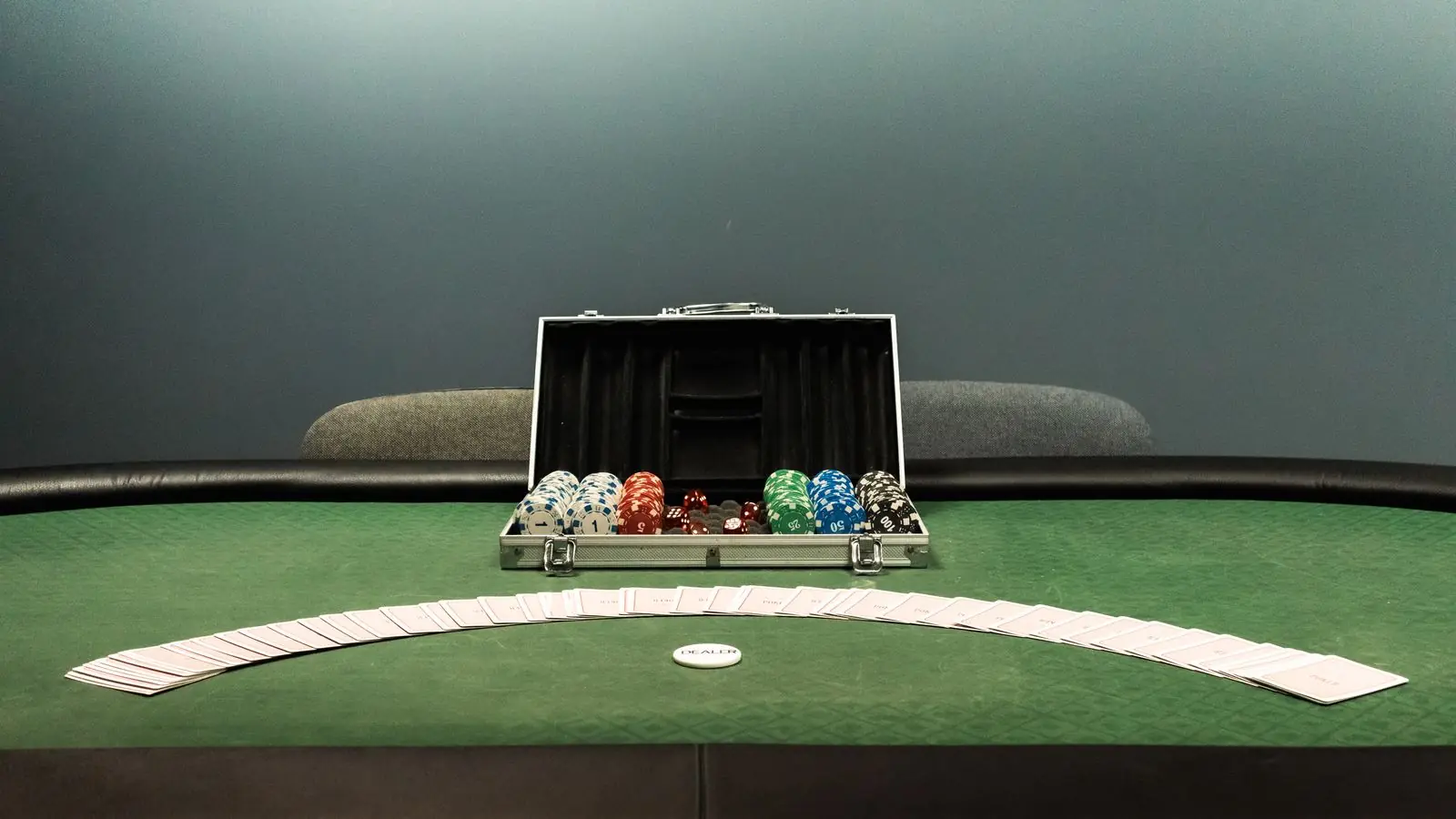
Photo: Dovydas Pranka / Pexels
Texas Hold'em rules from blinds to showdown, with betting limits, hand values, pot-odds maths and the legal position in the UK, US and India.
To play poker, you make the strongest five-card hand or get every opponent to fold. In Texas Hold’em, each player receives two private cards, five shared cards follow in three stages, and four betting rounds decide who wins the pot.
Poker is a card game in which players bet against each other into a shared pot. Texas Hold’em is the most common form: two hole cards per player, then a three-card flop, a one-card turn and a one-card river. A betting round follows the deal and each new stage. A hand ends when only one player is left or at showdown, where the highest five-card hand wins. Hand values follow ten ranks, from royal flush to high card. Real-money online poker is licensed in some markets and banned in others, including India since 1 May 2026.
The goal of a poker hand is to win the pot, the chips all players have bet during that hand. A player wins the pot in one of two ways: every other player folds, or the player shows the highest-ranking five-card hand at showdown.
This double route separates poker from house-banked casino games. In blackjack or roulette, the player bets against the casino. In poker, players bet against each other, and the card room earns a fee rather than a house edge. You can compare both models on our poker games page.
Two consequences follow from the double route:
At showdown, the rule is that “the cards speak for themselves” (Pagat.com). A player must show the hole cards to claim the pot, and the dealer reads the hand as it is, not as the player announces it.
A Texas Hold’em hand runs through four betting rounds. Two forced bets, the blinds, start the pot. Each player gets two hole cards. The flop adds three board cards, the turn adds a fourth and the river adds a fifth, with betting after each.
The sequence below follows Robert’s Rules of Poker (sections 4 and 5) and the house rules of The Venetian Resort Las Vegas:
| Stage | Cards added | Cards each player can use | Betting round |
|---|---|---|---|
| Pre-flop | 2 hole cards | 2 | 1st |
| Flop | 3 board cards | 5 | 2nd |
| Turn | 1 board card | 6 | 3rd |
| River | 1 board card | 7 | 4th |
A Texas Hold’em player builds the final hand from any five of the seven available cards. The Venetian lists three legal ways: two hole cards plus three board cards, one hole card plus four board cards, or all five board cards. The last option is called “playing the board”. From seven cards, a player can form 21 different five-card combinations (7 choose 5).
A poker player whose turn it is has five possible actions: check (pass when no bet is open), bet, call (match the current bet), raise (increase it) or fold (give up the hand). The betting structure decides how large each bet or raise may be.
| Structure | Bet size rule | Raise rule |
|---|---|---|
| Fixed limit | Set amounts: the small limit on the first two rounds, the big limit on the last two | A bet and three raises per round in games with three or more betting rounds |
| Pot-limit | Up to the size of the pot | Up to the pot size after the call is counted |
| No-limit | Any amount up to the player’s stack | At least the size of the previous bet or raise in that round; unlimited number of raises |
Sources: Robert’s Rules of Poker (sections 3 and 14) and The Venetian. Two worked examples show how the limits work in practice.
Pot-limit example. The pot holds $100 and an opponent bets $50. Robert’s Rules says the next player may call $50 and raise $200. The reason: after the call, the pot holds $100 + $50 + $50 = $200, and that $200 is the maximum raise. The total put in is $250.
No-limit example. Blinds are $1 and $2. A player raises to $6, which is a raise of $4. The next player who wants to re-raise must make it at least $10, because the raise must be at least as large as the previous raise ($6 + $4). An all-in for less is the exception.
At a poker showdown, the highest-ranking five-card hand wins the pot. Poker hand values run from royal flush down to high card, and a rarer hand always beats a more common one. Suits never break a tie, so identical five-card hands split the pot.
The table shows all ten hands with the chance of ending up with each one when seven cards are available, as in Texas Hold’em. The figures come from the seven-card frequency table published by Wizard of Odds (133,784,560 possible seven-card sets).
| Rank | Hand | Example | Chance with 7 cards |
|---|---|---|---|
| 1 | Royal flush | A♠ K♠ Q♠ J♠ 10♠ | 0.0032% |
| 2 | Straight flush | 9♥ 8♥ 7♥ 6♥ 5♥ | 0.028% |
| 3 | Four of a kind | Q Q Q Q 4 | 0.17% |
| 4 | Full house | J J J 6 6 | 2.60% |
| 5 | Flush | K♦ 10♦ 8♦ 4♦ 2♦ | 3.03% |
| 6 | Straight | 8 7 6 5 4 | 4.62% |
| 7 | Three of a kind | 7 7 7 K 2 | 4.83% |
| 8 | Two pair | A A 9 9 3 | 23.50% |
| 9 | One pair | 10 10 A 8 5 | 43.82% |
| 10 | High card | A J 9 6 3 | 17.41% |
When two players hold the same type of hand, the higher cards decide. Two pair is compared by the higher pair first, then the lower pair, then the fifth card (the kicker). The full ranking rules, including every tie-break, are in our guide Poker Hand Rankings: Every Hand from Royal Flush to High Card.
Probabilities guide poker decisions by comparing the chance of winning a hand with the price of calling a bet. A Texas Hold’em player counts outs, converts them into a percentage and calls only when the pot pays more than the risk.
A few starting numbers, calculated by our editorial team from a 52-card deck:
The 4-step pot-odds check turns these numbers into a decision:
Worked example. On the turn, the pot is $60. An opponent bets $20, so the pot is now $80. Calling costs $20 to win $80. The price is 20 ÷ (80 + 20) = 20%. A flush draw with one card to come completes 9 ÷ 46 = 19.6% of the time. 19.6% is below 20%, so the call loses a small amount on average, before counting any future bets. The concept behind this is expected value.
The same nine-out flush draw can be a clear call or a fold. Against an all-in bet on the flop, two cards are still to come and the draw completes 35.0% of the time, so a price of 20% to 30% is easily covered. Against a one-third-pot bet on the turn, the draw has 19.6% equity and the price is 20%, which is a marginal fold on pot odds alone. The hand name never changes; the number of cards to come and the bet size do. Beginners who learn the 4-step check before memorising starting-hand charts make fewer expensive calls.
Omaha uses the same board, blinds and hand rankings as Texas Hold’em, but each Omaha player receives four hole cards and must use exactly two of them with exactly three board cards. Omaha is usually played pot-limit, while Hold’em is often no-limit.
| Feature | Texas Hold’em | Omaha |
|---|---|---|
| Hole cards | 2 | 4 |
| Hole cards used in the final hand | 0, 1 or 2 | Exactly 2 |
| Five-card combinations per player | 21 | 60 (6 × 10) |
| Possible starting hands | 1,326 | 270,725 |
| Playing the board | Allowed | Not possible |
| Typical structure | No-limit or fixed limit | Pot-limit (Omaha Hi-Lo often fixed limit) |
| Players per table | 2 to 10 | 2 to 10 |
Sources: Robert’s Rules of Poker (section 6) and Pagat.com; combination counts calculated by our editorial team. The four-card deal makes strong hands far more common in Omaha, so a hand that wins often in Hold’em, such as top pair, wins less often in Omaha. The details are in Omaha Poker Rules: How Pot-Limit Omaha Differs from Hold’em.
Real-money online poker is legal only where a national or state law licenses it. Great Britain licenses operators through the UK Gambling Commission, the United States decides state by state, and India has banned all online money games, including skill games, since 1 May 2026.
India. The Promotion and Regulation of Online Gaming Act, 2025 was passed by Parliament in August 2025. Its rules came into force on 1 May 2026. The Press Information Bureau (PIB) explainer says the Act “imposes a complete ban on all forms of online money games”, and that the ban covers “games of chance, games of skill, and any mix of the two”. Banks and payment systems may not process these transactions. As of October 2026, real-money online poker is therefore not legally available in India. Details are on our India legal page.
In India, offering or facilitating an online money game can lead to up to three years in prison, a fine of up to ₹1 crore, or both; advertising one can lead to up to two years or ₹50 lakh (PIB, as of October 2026). The PIB and Nishith Desai sources describe penalties for operators, advertisers and payment providers; neither describes a penalty for players. Gambling Hero does not encourage anyone in India to play real-money online poker. In every market, check the operator’s licence first.
United Kingdom. Online poker sites serving British players need a UK Gambling Commission licence. Our UKGC licence page explains what that licence requires.
United States. There is no single federal answer. Each state decides whether online poker is legal. See our US legal overview before you sign up anywhere.
Poker played for money carries the risk of losing it. Set a budget before you sit down, and use the tools on our responsible gambling page if play stops being fun.
Texas Hold’em is easy to learn in an evening: two cards, five board cards, four betting rounds, ten hand ranks. What takes much longer is the betting. Most of the money that changes hands moves because of decisions about calling and folding, not because of the cards dealt. That is why we would put the 4-step pot-odds check ahead of any starting-hand chart. We also think beginners should learn rules and maths with play-money games first. The legal map matters too: real-money online poker is licensed in Great Britain, regulated state by state in the US, and banned in India as of October 2026. Check where you are before you play.
Each player gets two hole cards. Five community cards are added in three stages: three on the flop, one on the turn and one on the river.
Yes. A flush beats a straight because it is rarer. From a 52-card deck there are 5,108 five-card flushes and 10,200 straights.
Yes. In Texas Hold’em a player may use all five board cards. This is called playing the board, and it usually leads to a split pot. In Omaha it is not allowed.
The small blind is posted by the player left of the button; the big blind by the player two seats left of the button. The big blind is usually twice the small blind and sets the minimum bet.
No. As of October 2026, the Promotion and Regulation of Online Gaming Act, 2025 bans all online money games, skill games included. The rules have applied since 1 May 2026.
Industry
Who pays for a progressive jackpot, how the meter grows and resets, what the odds look like, and when the maths can…
October 25, 2026

Industry
How Jacks or Better pay tables work, why the five-coin bet matters, and the 16-step hold ladder that gets within 0.08% of…
October 25, 2026

Industry
Omaha poker rules in practice: the two-plus-three hand rule with examples, pot-limit raise maths, Hi-Lo splits and how PLO differs from Hold'em.
October 25, 2026